By the end of the second summer, the little white plastic tag that came with your new shrub has done one of three things. It has snapped at the base and disappeared into the mulch. It has migrated mysteriously to the far corner of the bed during weeding. Or — the most common fate — it has remained exactly where you stuck it, but the printing has bleached to a faint ghost of itself, the cultivar name now indistinguishable from the species, the species indistinguishable from blank plastic. You can read three letters. One of them might be a B.
This is the small, recurring tragedy of plant labeling, and every gardener who has ever bought more than a dozen plants has lived through some version of it. The good news is that the problem is entirely solvable, and at almost any budget. The trouble is that the solutions vary wildly in cost, durability, and appearance — and the right answer depends as much on the kind of gardener you are as on the plants themselves.
This is a guide to the full range of options, from the cheapest DIY markers to the slowest-aging copper tags to the digital approaches that skip physical labels entirely. None of them are perfect. Several of them, used together, come close.
Why Labels Matter More Than You Think
It’s tempting, when the garden is young and the plants are few, to assume you’ll remember everything. You won’t. Memory does not survive a winter, and certainly not a winter and a spring and a fall. The hydrangea you swore you’d recognize on sight turns out to look very much like its sister cultivar when neither is in bloom. The three heucheras you bought together in different shades grow into a single dense clump within two years.
Labels do four useful things. They tell you what you’re looking at, of course. They tell visitors, which matters if you’re the sort of gardener whose neighbors stop to ask. They tell future gardeners — the person who buys your house, the friend you give a division to — what they’re inheriting. And, perhaps most importantly, they tell you not to plant something else there, which is the failure mode of an unlabeled garden in early spring, when last year’s perennials are nothing more than crowns of bare earth.
What Makes a Label Worth Using
Before getting into specific options, it helps to know what you’re actually evaluating. A good plant label does four things: it survives the weather, it stays put, it remains legible, and it doesn’t ruin the look of the bed. Most labels do two of these well. A few do three. Almost none do all four.
The weather is the brutal part. Ultraviolet light eats printed ink in a single summer. Permanent marker, despite the name, is anything but. Cheap plastic embrittles after a year or two and snaps the first time you yank a nearby weed. Wood rots from the soil up. Even metal tags can corrode if the alloy is wrong or the wire loop wears thin.
The other failure modes are quieter but just as common. Stakes get bumped out of the ground during weeding and reinserted next to the wrong plant. Squirrels and dogs treat anything sticking out of the soil as a personal challenge. And labels that looked perfectly elegant in the catalog photo sometimes feel oddly aggressive in a real bed — a row of glossy white markers that turn a relaxed border into something resembling a museum exhibit.
The DIY Options
The cheapest labels you can make are honest about being cheap. Painted rocks work surprisingly well — a flat stone, a coat of light-colored exterior paint, and a permanent paint pen will last two or three seasons before fading, and they sit unobtrusively in the bed rather than standing up like flags. Slate paddles with chalk pen are a slightly fancier version of the same idea, with the added benefit that you can update them as the seasons change.
Popsicle sticks and wooden craft sticks belong in the seed-starting tray, not the garden. They will rot before the seedlings are six inches tall. Wine corks on bamboo skewers are charming for a single season of herbs and not much more. Repurposed plastic strips cut from yogurt containers, written on in pencil — yes, pencil; ink fades, graphite doesn’t — are genuinely durable and genuinely ugly, which makes them ideal for the vegetable garden and unwelcome in the front border.
If you have a wood-burning tool and a stack of cedar scraps, you can make labels that will last five or six years and look like they belong. Hand-stamping aluminum or copper tags, sold in craft stores for a few dollars, gives you something that will outlast most of the plants it labels.
The Store-Bought Physical Options
Cedar and bamboo stakes are the workhorses of the labeled garden. They cost very little, they look at home in any bed, and they last one to two years before the soil-line rot catches up with them. Refresh them annually and they’re a perfectly good system.
Plastic T-markers are cheaper still and last about as long, but they look like what they are, which is fine in the vegetable beds and less so among the roses. The printed ink on the pre-labeled versions fades in a single summer; write your own with a pencil or a paint pen and they’ll outlast the plastic itself.
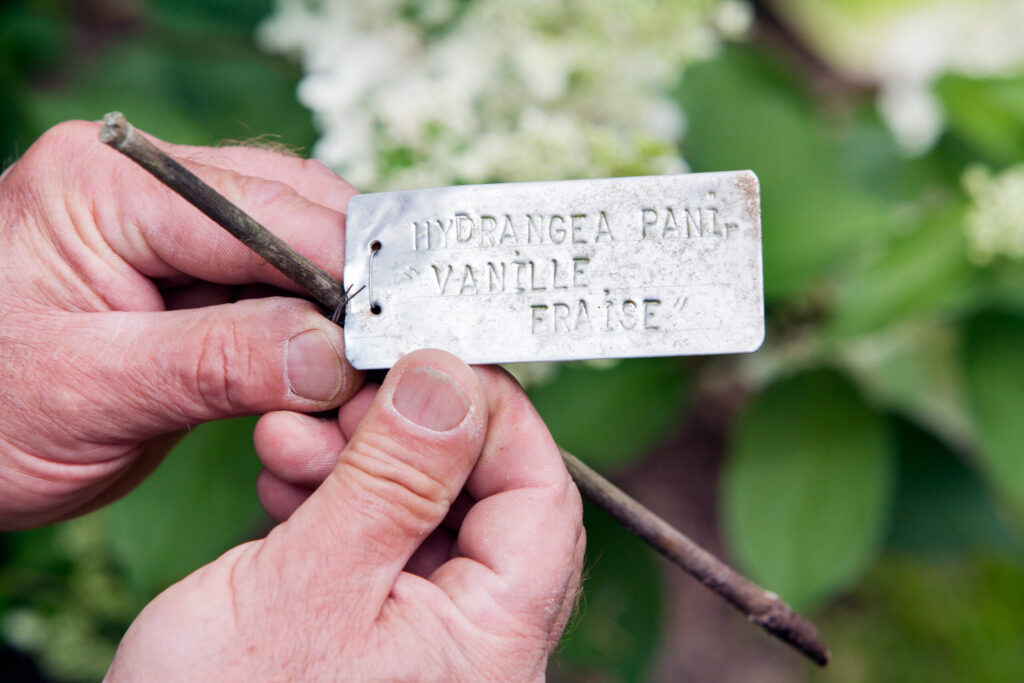
Aluminum and zinc tags, often sold as nursery markers, are the sweet spot for most serious gardeners. They are inexpensive, weather almost indefinitely, and can be engraved with nothing more than a ballpoint pen — you press hard enough to indent the metal, and the lettering becomes permanent. Hung from a wire stake or tied to a branch with a loop, they will outlast the gardener.
Copper labels are the prestige option. They start out bright and patina to a soft green over a few years, which many gardeners find beautiful and others find distracting. They are expensive, but they are functionally permanent, and a small collection of them on the specimen trees and signature shrubs is one of the quiet luxuries of a mature garden.
Engraved slate, stone, and acrylic markers exist mostly for display gardens and gift purposes. They look wonderful in photographs and crack when you accidentally clip them with a spade.
The Digital Approach
A growing number of gardeners have given up on physical labels entirely — or kept them only for the most important specimens — and moved their plant records into a phone instead. The idea is straightforward: a photo of each plant, tagged with the variety name and location, organized by bed or by zone, searchable in seconds. Walk into the garden with a question, pull out your phone, and the answer is one tap away.
The tradeoffs are real. A digital record can’t tell a visitor what they’re looking at, can’t be admired by the neighbor over the fence, and requires you to have your phone with you and charged. It also doesn’t fade, snap, get dug up by squirrels, or have to be replaced every two years. For gardens with a lot of plants — and especially for gardens where the gardener wants to keep notes alongside the names, like planting dates, sources, and care reminders — the digital approach can replace a hundred physical labels with a single searchable archive that survives every winter.
The Hybrid That Works Best
For most gardeners, the right answer is not a single system but two, layered. Use permanent physical labels — engraved aluminum or copper — for the plants that matter: specimen trees, signature shrubs, the prized perennials you’d be heartbroken to misidentify. Use a digital record to capture everything else, including the annuals, the herbs, the vegetables, and the constantly shifting cast of plants that doesn’t justify a permanent marker.
The physical labels handle the questions you ask while standing in the garden. The digital record handles the questions you ask while ordering seeds in January, planning next year’s beds in November, or trying to remember the variety of tomato that did so well two summers ago.
Done this way, the system survives the weather, the seasons, and the years. The little white plastic tag that came with the shrub will still bleach to a ghost by August. But by then, you won’t need it. You’ll already have written the name down somewhere it can’t fade.